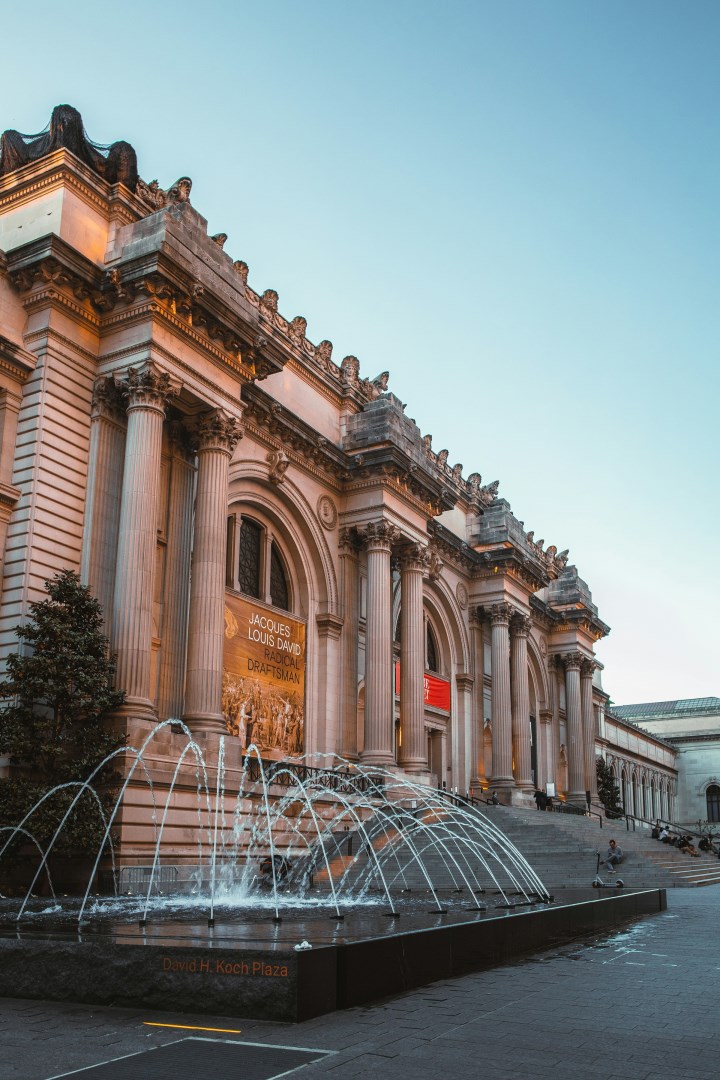
The Metropolitan Museum of Art, commonly called the Met, is one of New York City's largest cultural institutions, occupying a prominent position along Fifth Avenue beside Central Park. Its collection spans more than 5,000 years of human creativity and includes painting, sculpture, decorative arts, armor, musical instruments, photographs, and archaeological objects. The museum's main building contains extensive galleries arranged around the Great Hall, while the nearby Met Cloisters focuses on medieval European art and architecture. Together, the two locations present works from many cultures and regions within a single museum organization.
The Met's collections reflect the artistic traditions of civilizations across Africa, Asia, Europe, the Americas, and the ancient Mediterranean and Near East. Visitors can see Egyptian temples and artifacts, Greek and Roman sculpture, European paintings, Islamic decorative arts, Asian ceramics, American furniture, and Indigenous works. The museum also holds an extensive Costume Institute collection, which examines clothing and fashion as forms of artistic and cultural expression. Its breadth allows individual galleries to explore specific cultures and artistic traditions while also showing connections between different regions and periods.
Among the museum's notable works are Washington Crossing the Delaware by Emanuel Leutze, Self-Portrait with a Straw Hat by Vincent van Gogh, and a group of monumental Egyptian objects including the Temple of Dendur. The Met's Arms and Armor galleries contain elaborate weapons and protective equipment from Europe, Asia, and the Middle East. The American Wing includes period rooms and works by artists such as John Singer Sargent and Thomas Eakins. On the building's rooftop, seasonal installations and views across Central Park and Manhattan provide a different perspective on the city.
The Metropolitan Museum of Art also functions as a major research and conservation center, with libraries, archives, laboratories, and specialists studying works from its collections. Its public programs include lectures, performances, educational activities, and temporary exhibitions that place individual works within wider cultural contexts. The Met Cloisters in northern Manhattan complements the main museum with medieval sculpture, stained glass, manuscripts, and architectural elements arranged within reconstructed and adapted monastic spaces. Together, the Met's locations provide a broad survey of global art while also supporting detailed research into individual objects, artists, and traditions.






 Carnival Cruise Lines
Fun for All. All for Fun.
Carnival Cruise Lines
Fun for All. All for Fun.
 Celebrity Cruises
Nothing Comes Close
Celebrity Cruises
Nothing Comes Close
 Cunard Line
The Most Famous Ocean Liners in the World.
Cunard Line
The Most Famous Ocean Liners in the World.
 Disney Cruise Line
Magic Included!
Disney Cruise Line
Magic Included!
 Holland America Line
Savor the Journey.
Holland America Line
Savor the Journey.
 MSC Cruises



















































 Call Us